Impact and Initiatives
NCCF is dedicated to ensuring that every Northwest CT child has the fullest opportunity to grow, learn, and succeed. Poverty is the single largest predictor of child inequality because it affects nearly every aspect of a child's development. Poverty creates a cycle of disadvantage that can be challenging to break, perpetuating inequality across generations. We are focused on improving the lives of children in our communities who are the most vulnerable to adverse childhood experiences, so they have full access to the opportunities that lead them to a healthy, happy, and economically secure life.
NCCF seeks to ensure that every Northwest CT child has the fullest opportunity to “grow, learn, and succeed.” To achieve this goal, NCCF believes it must focus on children in our communities who are the most vulnerable to adverse childhood experiences so that they have full access to the opportunities that lead them to a healthy, happy, and economically secure life.
Nearly 800 or 16 percent of Northwest CT children under 5 years were living in poverty according to the 2022 American Community Survey1. Source: American Community Survey, 2022
The 2022 American Community Survey also estimated that 2,606 (13.9%) of all children under 18 years were living in poverty.
The Northwest CT towns with the highest number of children in poverty were Torrington (1,311), North Canaan (271), North Canaan (271), Washington (161) and Goshen (148).
Children in poverty are more likely to experience unstable living conditions, including overcrowded or unsafe housing. This instability can lead to higher stress levels and disrupt a child's sense of security and wellbeing.
Fact: For the 2023-24 school year, 34 students in PK-Grade 5 were reported as homeless. When the grade levels were expanded to PK-12, the number of reported homeless students grew to 682. While Torrington and Winchester were the only two school districts with reported homeless students, several school districts had homeless students whose data were suppressed due to their small number to protect privacy.
2 Source: CT DOE EdSight database, 2023-24 School Year
Poverty can limit access to adequate and nutritious food, leading to poorer physical health and development. Chronic health issues or malnutrition can impede a child's ability to learn and thrive.
Feeding America estimated that in 2022 there were over 3,000 children under 18 years of age in the Northwest Hills Planning Region who were food insecure. Source: Feeding America Map the Meal Gap Study database, 2022
The 2022 Feeding America estimates were that 3,220 children or 15% of all those under 18 years of age were food insecure. In addition, nearly 60% of the region’s children were estimated to be eligible for SNAP benefits.
Four in ten students (40%) in Northwest Connecticut are eligible for free or reduced priced meals. Source: CT DOE EdSight database, 2023-24 School Year
- More than 4,600 Northwest CT students are eligible for free or reduced priced meals.
- The school districts with the highest numbers and percentages are Torrington (2,642; 67%) and Winchester (365; 59%).
- North Canaan has a smaller number (104) but a higher percentage (42.6%).
- Litchfield and Regions 6, 10 and 14 have smaller percentages, but notable numbers of students who are eligible for free or reduced priced meals.
Poverty often results in limited access to pediatric care, health and developmental screenings, and safe living environments (e.g., lead- and smoke-free homes).
These conditions increase the risk of persistent illnesses and developmental delays. The ultimate impact is a cycle of chronic poor health and reduced opportunities, making it harder for children to reach their full potential.
Children from low-income families often have limited access to quality early education and developmental resources. Children living in poverty often lack necessary materials and experienced teachers, affecting the quality of cognitive skills, and social emotional development. Financial constraints can limit children’s participation in organized enrichment activities, such as sports, arts, or camps, which are often crucial for personal development and social skills.
While Northwest CT school districts exceed the state average for the 3rd grade English Language Arts Performance Index (70.2 compared to the state average of 65.8), Torrington and Winchester fall below the state average (60.2 and 64.2, respectively) Source: CT DOE EdSight database, 2022-23 School Year
The CT Department of Education has set a target goal of 75% proficiency for all districts.
Regional Early Childhood Alliance
In 2021, the NCCF established the Regional Early Childhood Alliance (RECA). RECA is a partnership of community residents and individuals to enhance the wellbeing of our youngest children (0-8) and their families. RECA exists as a network working to value, support, and strengthen organizations, structures, and systems that improve the lives of children and families in our region.
Partnership in RECA:
Creates a stronger unified regional voice to advocate on behalf of all children and their families in living in Northwest Connecticut.
Engages in system building efforts to enhance and strengthen an easily accessible regional early childhood continuum of care.
Provides Collaboration for best practices among various community stakeholders including local, state and national experts.
Strengthens existing networks through cross-sector collaboration and relationship building.
Encourages Networking for funding opportunities to enhance to enhance local, regional, or state services and programs.
Informs funders and local, state and federal leaders of family and community needs and priorities.
Enhances and strengthen early childhood and family services by including the voice of parents, caregivers, and community residents in discussions about policies and services affecting them.
Grants Provide Food and Shelter
In 2024, more than 55 grants supported programs that enabled individuals and families in need to access emergency shelters and affordable housing opportunities, and to benefit from food pantry staples–fresh fruits, meats and vegetables–to sustain them through tough times
Through more than $1.5 million in grants since 2022, Northwest CT nonprofits have helped local children experience quality
pre-k educational programs, afterschool enrichment activities, summer camp programs.
NCCF is a Member of End Child Poverty Now
NCCF is a dedicated member of group of change leaders in CT have created a unified platform for advocacy that is positively impacting our communities. By combining the strengths of foundations, nonprofits, advocacy groups, and community members behind a shared vision to End Child Poverty Now, we can more effectively work towards positive, lasting change in Connecticut and beyond.
Our advocacy collaborative envisions a thriving and economically robust CT, where no child experiences the debilitating effects of poverty. We believe that every child deserves access to basic necessities, quality education, and a nurturing environment that fosters their physical, emotional, and intellectual growth. We engage with lawmakers and policy influencers to promote and enact policies that address the root causes of child poverty.
Legislative Advocacy
NCCF engages with lawmakers and policy influencers to promote and enact policies that address the root causes of child poverty, including income inequality, access to healthcare, safe and affordable homes, and quality education.
In 2024, we lobbied for paid sick days which previously only covered 12% of workers in CT. The bill was passed by the legislation, expanding paid sick leave to nearly all workers, guaranteeing 40 hours of paid sick leave annually, introducing broader protections, and setting a model for other states.
In addition, lobbying efforts resulted in partial coverage of no-cost healthy meals for children from families with lower incomes. We continue to lobby to make this a benefit for all students.
In 2025, advocates, the Office of Early Childhood, families of young children, and early childhood educators made their voices heard at the Capitol. Thanks to those voices, legislators and the governor enacted legislation that will establish the Early Childhood Education Endowment.
The Endowment will increase salaries and health care plans for early childhood workers and provide funding for childcare facility improvements.
Current legislative priorities include:
• Support permanent, refundable CT Child Tax Credit at $600 per child.
• Support universal no-cost healthy school meals (breakfast, lunch, and afternoon snack).
• Expand Care4Kids childcare subsidies for families earning up to 85% of the State Median Income.
• Expand good cause eviction protections to support family housing stability.
NCCF works alongside partners such as the United Way of CT, End Hunger CT, and Partnership for Strong Communities to provide testimony, meet with lawmakers, and inform the community so that important laws are passed and successfully implemented.
"I don’t know what the future will hold, but I know who holds the future."
- (Reverend) Ralph David Abernathy, Sr.
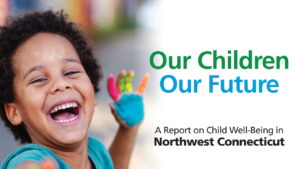
–A Report on Child Wellbeing in Northwest CT
Our Children Our Future
Decades of research on child development, coupled with a worldwide COVID 19 pandemic, have brought us to a watershed moment by clearly illuminating the structural inequities facing young children and their families.